


 Germany’s most populous state is also one of its most varied culinary regions. North Rhine-Westphalia (Nordrhein-Westfalen or NRW) stretches from the great Rhine cities of Bonn, Cologne and Düsseldorf through the former coal and steel cities of the Ruhrgebiet, across the flat Lower Rhine countryside bordering the Netherlands, into the wooded hills of the Bergisches Land and Sauerland, and eastward to the farms and historic towns of Westphalia.
The state may be one political unit, but its food traditions are anything but uniform. The modern state was created after World War II, combining the northern part of the former Prussian Rhine Province with Westphalia and, shortly afterward, Lippe. Those older regional identities are still surprisingly easy to taste.
For food lovers, it helps to think of North Rhine-Westphalia as four broad culinary regions:
North Rhine – Cologne, Bonn and Düsseldorf, with Kölsch and Altbier, Sauerbraten, mustard, herbal liqueurs, potato dishes and a particularly lively Brauhaus culture.
The Ruhrgebiet and Lower Rhine (Niederrhein) – from Dortmund, Bochum and Essen westward through Duisburg and Krefeld toward Xanten, Kleve and the Dutch border. Here industrial working-class cooking and international immigrant influences meet the agricultural traditions of the Lower Rhine.
The Bergisches Land and Sauerland – the wooded hill country east of the Rhine and south of the Ruhrgebiet, from Wuppertal, Solingen and Remscheid toward Gummersbach, Arnsberg, Meschede, Schmallenberg and Winterberg. Here waffles, breads, coffee-table traditions, local beers, forests and hearty country cooking create a very different side of NRW.
Westphalia – Münster, Bielefeld and Ostwestfalen-Lippe, characterized by rye and pumpernickel breads, ham, sausages, potatoes, buckwheat and substantial farmhouse cooking.
Many foods and beverages from these regions – mustard, breads, beer, liqueurs, preserves, syrups, chocolates and packaged specialties – can make their way to American tables. Others are best experienced where they originated: freshly poured Kölsch in a Cologne Brauhaus, Currywurst at a Ruhrgebiet Imbiss, freshly harvested Lower Rhine asparagus, a Bergische Kaffeetafel in a country inn, or Westphalian bread and ham at a Münster market.
For dishes from throughout the state, explore our Recipes from North Rhine-Westphalia.
Explore North Rhine-Westphalia region by region. Click each region below to discover its culinary traditions and regional products, local beers and specialties, German-American connections, and recommended places to taste the foods where they originated.
North Rhine – Cologne, Bonn and Düsseldorf
The Region
The Rhine has shaped this part of NRW for two thousand years. Roman settlements grew into trading cities; medieval merchants shipped wine, grain and other goods along the river; Cologne became one of Europe’s great ecclesiastical and commercial centers; and Düsseldorf developed into a center of trade, administration, fashion and culture.
Cologne, Bonn and Düsseldorf are close enough to visit on the same trip, yet their culinary identities remain surprisingly distinct. Nowhere is that difference more apparent than in their beer.
Culinary Culture and Regional Products
Kölsch: Cologne’s Beer
 Kölsch is Cologne’s signature beer: pale, refreshing and top-fermented, but cold-conditioned for a particularly clean taste. Traditionally it arrives in a tall, narrow 0.2-liter glass called a Stange.
Brands such as Früh, Gaffel, Reissdorf and Sion have carried Cologne’s brewing tradition well beyond the city, so bottled Kölsch offers Americans an accessible introduction to the style. But the real Kölsch experience includes the Brauhaus itself and the Köbes, the traditional brewery waiter who replaces an empty glass with a fresh one until the drinker signals that enough is enough.
Altbier: Düsseldorf’s Answer to Cologne
Only about 25 miles downriver, Düsseldorf has preserved another old top-fermented beer tradition: Altbier. Alt is generally darker, copper-colored and more assertively hoppy than Kölsch.
Some Düsseldorf Altbier is bottled, but much of its identity remains tied to traditional house breweries. The friendly – and occasionally not-so-friendly – rivalry between Kölsch and Alt is part of the cultural identity of both cities.
Düsseldorf Mustard
Düsseldorf also has one of Germany’s best-known mustard traditions. Düsseldorfer Mostert is a pungent local mustard historically based on brown mustard seed and traditionally associated with the city’s breweries, sausages and meat dishes.
Mustard is one of the regional specialties that travels particularly well and is an easy way to bring Rhineland flavor to sausages, roast meats, sandwiches and salad dressings in an American kitchen.
Killepitsch
Another Düsseldorf specialty that can cross the Atlantic is Killepitsch, a dark herbal liqueur developed by the Busch family and first served in the 1950s. Made with extracts of numerous herbs, fruits and berries, it is traditionally enjoyed as a digestif.
Rheinischer Sauerbraten
Rheinischer Sauerbraten is perhaps the best-known Rhineland dish. Beef is marinated for several days before slow cooking, and the finished gravy combines distinctly sweet and sour flavors. Raisins and sometimes gingerbread or another sweet ingredient distinguish the Rhineland version from Sauerbraten found elsewhere in Germany.
You can find a version in our North Rhine-Westphalia recipe collection.
Himmel un Ääd
Himmel un Ääd – “Heaven and Earth” – combines apples from the trees, representing heaven, with potatoes from the earth. It is traditionally accompanied by fried blood sausage and onions.
Reibekuchen and Halve Hahn
 Reibekuchen, crisp potato pancakes usually eaten with applesauce, remain one of the region’s favorite street foods and market snacks.
Cologne’s wonderfully misleading Halve Hahn, meanwhile, contains no chicken at all. It consists of a rye roll with aged Gouda, mustard, onions and often pickles. It is classic simple Brauhaus food.
Travel & Taste: What to Experience There
Cologne
Begin at the magnificent Cologne Cathedral (Kölner Dom), then explore the lanes of the Altstadt and its traditional Brauhäuser.
Früh, Päffgen, Malzmühle, Sion and other brewery restaurants provide the full Kölsch experience: fresh beer in small glasses, communal tables, quick-witted Köbes and hearty local food. Order Himmel un Ääd, Reibekuchen, Sauerbraten or a Halve Hahn rather than simply choosing familiar German restaurant fare.
Then walk along the Rhine to the Chocolate Museum (Schokoladenmuseum), which follows cocoa and chocolate from its early history through modern production. It is one of Germany’s most enjoyable food-related museums.
Bonn
Upstream, Bonn combines Rhineland food culture with music and modern German history. Explore Beethoven’s birthplace and the historic center before visiting the Museumsmeile, particularly the Haus der Geschichte for postwar German history.
For something distinctly local, visit Brauhaus Bönnsch. Its naturally cloudy, top-fermented Bönnsch beer is brewed in the city and traditionally served in a distinctive curved glass. This is exactly the sort of specialty where the setting is as important as the beverage.
Düsseldorf
 Düsseldorf’s Altstadt contains hundreds of pubs, restaurants and bars in a remarkably compact area, earning it the popular nickname “the longest bar in the world.”
Walk between traditional breweries such as Uerige, Füchschen, Schumacher and Schlüssel and compare their Altbier fresh from the barrel.
Look for Düsseldorfer Senfrostbraten – beef topped with a pungent mustard crust – or another Rhineland specialty, followed by a Killepitsch at the tiny Et Kabüffke.
The Carlsplatz Markt is another worthwhile culinary stop, with produce, meats, cheeses, baked goods, prepared foods and international specialties.
Ruhrgebiet & Lower Rhine (Niederrhein)
The Region
 The Ruhrgebiet grew around coal, iron and steel. During the 19th and 20th centuries, mines, coke works, blast furnaces and factories transformed towns into one of Europe’s largest industrial regions.
Workers arrived first from nearby German regions and Poland and later from Italy, Turkey, Greece, the former Yugoslavia and elsewhere. The resulting food culture is less about courtly culinary traditions than about filling working-class food, immigration and everyday eating.
Travel west from Essen and Bochum toward Duisburg and the landscape begins to change. Beyond the industrial Ruhr stretches the flat, green Lower Rhine or Niederrhein, including Krefeld, Wesel, Xanten, Geldern, Kleve, Emmerich and the countryside along the Dutch border.
Duisburg forms something of a geographical hinge between the two worlds: industrial Ruhrgebiet to the east and the broader Rhine landscape to the west and north.
Culinary Culture and Regional Products
Currywurst and Pommes
 Few foods symbolize modern Ruhrgebiet culture better than Currywurst mit Pommes: sausage covered with curry-spiced tomato sauce and accompanied by fries, frequently with mayonnaise.
The concept sounds simple, but sauces, sausages and local loyalties differ considerably between snack bars. Curry ketchup and German sausages can certainly be enjoyed in America. Eating Currywurst standing at a neighborhood Imbiss amid Ruhr dialect and soccer conversations is harder to export.
Dortmunder Beer
 Dortmund was once one of Europe’s great brewing centers. Its name became particularly associated with Dortmunder Export, a pale, bottom-fermented lager that developed during the city’s industrial boom in the 19th century.
The classic Dortmunder sits stylistically between a Pils and a Munich Helles: smooth and balanced, with more body than a typical Pils but a firmer hop character than a Helles. Dortmund’s mineral-rich brewing water also helped shape the style.
Unlike Cologne’s Kölsch or Düsseldorf’s Altbier, Dortmund’s brewing tradition increasingly followed the bottom-fermented lager culture that spread across Germany during industrialization.
Dortmunder Beer Across the Atlantic
Dortmund’s beer tradition traveled surprisingly far. The city’s breweries entered overseas markets during the late 19th century; Dortmunder Actien-Brauerei, or DAB, was already shipping casks overseas by 1879 and installed an early mechanical refrigeration system supervised by refrigeration pioneer Carl Linde in 1881.
The Dortmunder style later became part of international brewing culture. American breweries have produced their own versions of Dortmunder or Export lager, keeping the name of this Ruhrgebiet city alive on American beer menus more than a century after the style developed.
Pfefferpotthast
A much older Dortmund specialty is Pfefferpotthast, a substantial beef-and-onion stew prominently seasoned with pepper. Its roots reach back centuries, long before coal and steel transformed Dortmund.
Dortmunder Salzkuchen
Dortmunder Salzkuchen is a savory yeast roll traditionally sprinkled with salt and caraway. Locally it may be eaten with Mett – seasoned raw minced pork – and onions.
Fresh Mett is a perfect example of a German specialty best experienced locally rather than exported to the United States.
Essen and the Origins of ALDI
 The Ruhrgebiet also produced one of the world’s most influential grocery concepts. ALDI traces its roots to Essen, where the Albrecht family operated a grocery business in the early 20th century. Karl and Theo Albrecht later developed the highly efficient discount concept that became Albrecht Diskont – ALDI – and eventually expanded far beyond Germany, including across the United States.
Niederrhein: Asparagus, Potatoes and Farm Produce
Beyond the Ruhr, the food landscape becomes increasingly agricultural. The Lower Rhine’s sandy soils are particularly well suited to asparagus, potatoes, cabbage and strawberries, while apples and other orchard fruits are also important.
One of the most distinctive specialties is Walbecker Spargel, asparagus from the Lower Rhine around Geldern, Straelen and Kevelaer. During the spring asparagus season, roadside stands, farm shops and restaurants throughout the region celebrate the local harvest.
Apfelkraut and Rübenkraut
Apfelkraut and Rübenkraut are thick fruit and sugar-beet syrups traditionally spread on bread or used in cooking. Unlike fresh asparagus, these concentrated spreads travel well and provide an easy way to taste a piece of Rhineland farmhouse culture abroad.
Buckwheat, Potatoes and Mussels
Traditional Lower Rhine cooking includes buckwheat pancakes with bacon, potato dishes, Endivienstampf – mashed potatoes combined with endive – cabbage dishes, beet salads and apple fritters.
Mussels are another long-established Rhineland favorite. The Rhine historically connected the region with the Netherlands and North Sea ports, allowing mussels and other products from the coast to reach inland tables.
Niederrheinische Kaffeetafel
The Lower Rhine also has its own substantial coffee-table tradition. A Niederrheinische Kaffeetafel combines sweet and savory foods: white and raisin breads alongside dark bread, ham, liver sausage and salami, together with plum preserves, sugar-beet syrup, apple cake or Bienenstich.
Raisin bread topped with cheese may surprise American visitors, but sweet-savory combinations are characteristic of this regional meal.
Travel & Taste: What to Experience There
Essen
 Visit the Zollverein Coal Mine Industrial Complex, now a UNESCO World Heritage Site. The former mine and coking plant has been transformed into a spectacular complex of museums, architecture, cultural venues and restaurants.
Then seek out a neighborhood restaurant or Imbiss. Essen’s immigrant communities also make Turkish, Balkan, Italian, Middle Eastern and other cuisines part of the contemporary Ruhr food experience.
Dortmund
Combine the Dortmund Brewery Museum with a brewery, beer hall or neighborhood pub. Try Dortmunder beer together with Pfefferpotthast or Salzkuchen.
Dortmund’s combination of beer, soccer and Büdchen kiosk culture provides a particularly good introduction to everyday Ruhrgebiet life.
Bochum
The German Mining Museum (Deutsches Bergbau-Museum) tells the story of the industry that created much of the modern Ruhrgebiet.
Afterward, look for Currywurst at a busy local Imbiss. Bochum has an especially strong association with Currywurst culture, and this humble meal may tell you more about the Ruhr than a formal restaurant ever could.
Duisburg: Where Ruhr Meets Rhine
Visit Duisburg’s enormous inland harbor and the extraordinary Landschaftspark Duisburg-Nord, where blast furnaces and steelworks have been transformed into a public recreation and cultural landscape.
Travel north from Duisburg and the scenery gradually changes from industrial Ruhr to the fields, river meadows and smaller towns of the Niederrhein.
Krefeld and the Lower Rhine
Krefeld belongs culturally more to the Lower Rhine than to the core Ruhrgebiet. Historically famous for textiles and silk, it is a useful gateway into the more rural Niederrhein.
Continue into the countryside for farm shops and country cafés selling regional breads, asparagus in spring, strawberries in early summer, potato dishes, preserves and apple or sugar-beet syrup.
Xanten: Romans on the Rhine
 Xanten provides an entirely different historical experience. The Archaeological Park reconstructs significant parts of the Roman city Colonia Ulpia Traiana, while the medieval town and cathedral add another historical layer.
Combine the archaeological sites with a country inn, farm café or bicycle ride through the surrounding Rhine landscape.
Kleve and the Dutch Border
Farther north, Kleve, Goch and Emmerich lie close to the Netherlands. Foods, dialects, agriculture and everyday customs have crossed this border for centuries.
It is easy to combine the German Lower Rhine with nearby Dutch cities such as Nijmegen. Doing so helps explain why this border region sometimes feels culturally as connected to the Netherlands as it does to Cologne.
Bergisches Land & Sauerland
The Region
 Travel east from Cologne and Düsseldorf and NRW quickly changes character. Dense cities and the broad Rhine valley give way to rolling hills, river valleys, reservoirs, forests and smaller towns.
The Bergisches Land takes its name not simply from its hills – Berg means mountain – but from the medieval Counts and Dukes of Berg, whose territory once covered much of the area.
At its more urban western edge are Wuppertal, Solingen and Remscheid, sometimes promoted together as the “Bergische Drei.” Beyond them lie smaller towns and communities including Bergisch Gladbach, Wipperfürth, Lindlar, Engelskirchen, Gummersbach, Wiehl and Waldbröl.
Continue east and southeast and the hills become higher and the forests more extensive. The Sauerland includes towns such as Arnsberg, Iserlohn, Attendorn, Olpe, Meschede, Brilon, Schmallenberg, Warstein and Winterberg.
With its forests, upland meadows, lakes, reservoirs and mountains, the Sauerland is one of NRW’s major destinations for hiking, cycling and winter sports. Together, Bergisches Land and Sauerland provide a green counterpoint to the metropolitan Rhine and Ruhr regions.
Culinary Culture and Regional Products
Bergische Kaffeetafel: Much More Than Coffee and Cake

The culinary signature of the Bergisches Land is undoubtedly the Bergische Kaffeetafel.
Calling it “coffee and cake” seriously understates the occasion. A traditional Kaffeetafel combines sweet and savory foods into an extended communal meal. Expect several kinds of bread, butter, Quark, cheese and cold cuts alongside honey, apple or sugar-beet syrup, rice pudding, raisin bread and, above all, Bergische waffles with hot cherries and whipped cream.
Depending on the host or restaurant, the table may include Krentensemel or raisin bread, dark rye bread, farm cheese, smoked ham, sausages, eggs and cakes.
The Dröppelmina
Coffee is traditionally served from the wonderfully named Dröppelmina, a bulbous pewter coffee urn resting on three feet and fitted with a tap. Its tendency to “dröppel” – drip – helped inspire the affectionate name.
Today the Dröppelmina is as recognizable a symbol of Bergisch hospitality as the waffle itself.
Waffles, Cherries, Rice Pudding and Fruit Spreads
Several parts of the Bergische Kaffeetafel translate particularly well to an American kitchen.
Bergische waffles are traditionally accompanied by hot sour cherries and whipped cream, sometimes together with rice pudding sprinkled with cinnamon and sugar. Fruit preserves, apple butter, Apfelkraut, Rübenkraut, rye bread and German-style coffee can recreate at least part of the experience at home.
Our North Rhine-Westphalia recipe collection includes Bergische waffles.
A Region of Farms, Mills and Early Industry
The Bergisches Land developed an unusual mixture of agriculture and small-scale industry. Fast-flowing rivers provided power for mills, grinding shops and metalworking long before large factories arrived.
Solingen became internationally famous for knives, scissors and blades; Remscheid for tools and metalworking; and the Wupper valley around Wuppertal for textiles, chemicals and manufacturing.
Nearby farms supplied butter, Quark, eggs, bread, fruit and meat, while industrial workers relied on potatoes, sausages and other substantial, economical foods. The cuisine therefore sits somewhere between Rhineland traditions and rural farmhouse cooking.
Solingen in American Kitchens
The Bergisches Land also has a surprisingly long connection with American food culture – through the kitchen rather than the pantry. Solingen knives and cutlery were exported to North America in large quantities more than a century ago.
American importers sometimes had their own company names placed on German-made knives, but they still wanted the blades identified with “Solingen”. The name of the city itself had become a mark of quality.
In that sense, Solingen has been present in American kitchens for generations. Even consumers who knew little about the Bergisches Land could recognize the name on a carving knife, kitchen knife or set of cutlery.
Sauerland: Forests, Farms and Hearty Food

In the Sauerland, the cuisine becomes even more closely connected to upland agriculture and forests. Potatoes, cabbage, pork, sausages, ham and substantial breads traditionally formed the backbone of everyday cooking.
Mushrooms, berries and game connect the kitchen to the extensive forests, while trout and other freshwater fish appear around streams, rivers and reservoirs.
Rather than being defined by one universally famous “Sauerland dish,” the region is characterized by a collection of hearty country foods: potato dishes, sausages, cured meats, roasts, game, trout, mushrooms and dark breads, often served in country inns.
Sauerland Beer: Warsteiner and Veltins

The Sauerland’s best-known culinary exports are arguably its beers. Warsteiner, from Warstein, and Veltins, from Grevenstein near Meschede, developed from small regional breweries into nationally and internationally recognized brands.
Both are associated primarily with Pilsener, or Pils – a pale, crisp, bottom-fermented lager. That makes the Sauerland brewing tradition quite different from the older top-fermented Kölsch and Altbier traditions preserved in Cologne and Düsseldorf.
Why Pilsener in the Sauerland?
Pilsener did not originate in the Sauerland. The style began in Plzeň (Pilsen) in Bohemia in 1842, where Bavarian brewer Josef Groll helped create a new golden, bottom-fermented lager.
The beer became enormously popular and spread rapidly across Germany and Central Europe during the second half of the 19th century. Expanding rail networks helped breweries distribute beer over greater distances, while mechanical refrigeration made it increasingly possible to maintain the low temperatures required for bottom-fermented lager throughout the year.
The Sauerland had another important advantage: very soft spring water, particularly well suited to pale Pilsener-style beers.
Veltins traces its brewery in Grevenstein to 1824 and credits the exceptionally soft water surrounding Grevenstein as an important part of its brewing history. The brewery later concentrated increasingly on beer brewed according to the Pilsener method.
Warsteiner traces its history in Warstein to 1753. The discovery of the exceptionally soft Kaiserquelle spring in the Arnsberg Forest in 1927 further shaped the brewery’s development. In 1977 Warsteiner made the strategic decision to concentrate production on Pilsener.
The Sauerland’s Pils tradition is therefore better understood as part of the broader technological and stylistic transformation of German brewing than as the result of Czech immigration. Ironically, the original Pilsener itself was created in Bohemia with the help of a Bavarian brewer.
The contrast within NRW is fascinating: while Cologne and Düsseldorf retained distinctive older top-fermented beer cultures, large breweries in the Sauerland embraced the bottom-fermented Pilsener style that became dominant across much of Germany.
From the Sauerland to Milwaukee – and Back
There is even a direct German-American chapter in the history of Veltins. Clemens Veltins spent six years traveling and learning the brewing trade before taking over the small Grevenstein brewery in 1852. One of the places he visited was Milwaukee, Wisconsin, already emerging as an important center of American beer brewing.
This was no coincidence. During the 19th century, large numbers of German immigrants helped transform Milwaukee, Cincinnati, St. Louis and other American cities into major brewing centers. German brewers brought knowledge of lager brewing, yeast management, malting and beer-garden culture with them.
Clemens Veltins returned to the Sauerland and expanded the family brewery. In 1883 he built a new brewing facility in Grevenstein equipped with steam power and an ice-making machine – precisely the kinds of technologies that were revolutionizing lager production on both sides of the Atlantic.
The story creates an intriguing circle of influence: German brewing traditions traveled with immigrants to America, Milwaukee became one of the world’s great German-American beer cities, and a Sauerland brewer traveled there to learn before returning home to build the enterprise that eventually became Veltins.
Travel & Taste: What to Experience There
Wuppertal
Wuppertal is the largest city in the Bergisches Land and one of NRW’s most unusual urban destinations.
Its famous Schwebebahn, the suspended railway running largely above the Wupper River, has operated for more than a century and remains unlike almost any other urban transit experience.
The city also offers the Von der Heydt Museum, the legacy of choreographer Pina Bausch and lively neighborhoods such as the Luisenviertel. Then head into the surrounding hills for a Bergische Kaffeetafel.
Solingen and Schloss Burg
Solingen is internationally synonymous with blades and cutlery. The German Blade Museum and historic grinding workshops explain an industry whose products have traveled around the world for centuries – including to American kitchens.
Nearby Schloss Burg, dramatically positioned above the Wupper, was an important residence of the Counts of Berg, the dynasty that gave the entire Bergisches Land its name.
The castle area is also one of the most atmospheric places to look for Bergisch cafés serving waffles or a complete Kaffeetafel.
Remscheid and Müngsten
Remscheid, another historic center of German toolmaking, lies across the Wupper.
Between Remscheid and Solingen rises the spectacular Müngstener Brücke, Germany’s highest railway bridge. Walking trails and parkland beneath the bridge make this an excellent excursion to combine with regional food.
Lindlar, Gummersbach and Rural Bergisches Land
Continue through Lindlar, Engelskirchen, Gummersbach, Wiehl and Wipperfürth for the more rural face of the region.
The LVR Open-Air Museum in Lindlar is particularly valuable for understanding how people once farmed, cooked and worked in the Bergisches Land. Historic farmhouses, workshops and demonstrations place the region’s traditional foods in their original setting.
The surrounding countryside is rich in reservoirs, forests and walking trails. A hike followed by waffles, cherries and coffee is one of the simplest ways to understand Bergisch food culture.
Arnsberg: Gateway to the Sauerland

Arnsberg, with its historic old town and hilltop castle ruins above the Ruhr River, provides an attractive western gateway to the Sauerland.
Its combination of historic architecture, forests and country restaurants marks the transition from the industrial Ruhr valley to the more rural Hochsauerland.
Attendorn and the Biggesee
Around Attendorn and Olpe, the landscape is dominated by forests, hills and the Biggesee, one of the Sauerland’s major reservoirs.
Attendorn’s famous Atta Cave (Atta-Höhle) provides an unusual underground attraction. Combine the cave with a lake excursion and a meal featuring local meat, potatoes, trout or seasonal game.
Schmallenberg
The countryside around Schmallenberg is particularly well suited to travelers looking for the classic Sauerland combination of hiking and country food.
Small villages, half-timbered houses, wooded hills and country inns surround the town. Look here for specialties that seldom become export products: freshly prepared venison and other game in season, trout, mushrooms, local sausages and substantial country cooking.
Winterberg and the Hochsauerland
Winterberg is perhaps the Sauerland’s best-known resort town. The surrounding Hochsauerland contains some of NRW’s highest elevations and attracts hikers and mountain bikers in summer and winter-sports enthusiasts during snowy months.
Nearby Kahler Asten is one of NRW’s best-known mountains. After a day outdoors, the logic behind Sauerland cooking becomes obvious: potatoes, sausages, roasts, bread, game and beer suit the landscape perfectly.
Warstein and Grevenstein: Follow the Beer
Beer enthusiasts can make Warstein a culinary destination in its own right and connect the familiar Warsteiner name with the wooded landscape where the beer originated.
Near Grevenstein, the home of Veltins provides the same opportunity – with the added curiosity that one of the brewery’s formative figures once traveled all the way to Milwaukee as part of his brewing education.
For American visitors, this can be an interesting reversal. Instead of discovering an unfamiliar German product, you discover the landscape and history behind a beer you may already have encountered at home.
Westphalia – Münster, Bielefeld and Ostwestfalen-Lippe
The Region

Travel north and east and NRW changes once again. Westphalia (Westfalen) is historically a land of farms, mills, grain and livestock.
Its traditional food culture grew around rye, buckwheat, potatoes, pigs, dairy products and preservation. The result is a cuisine of dense breads, smoked and cured meats, sausages, soups and substantial farmhouse dishes.
Our North Rhine-Westphalia recipe collection reflects this agricultural tradition with beans, potatoes, buckwheat, pork and other regional ingredients.
Culinary Culture and Regional Products
Westphalian Bread Culture and Pumpernickel
Westphalian Pumpernickel is among Germany’s most distinctive breads. Traditional pumpernickel is based primarily on rye and baked or steamed for many hours at low temperature, producing its characteristic very dark color, dense texture and subtle sweetness.
Its durability once made it practical farmhouse and travel food. Today it is also one of Westphalia’s easiest culinary traditions to export and enjoy in America.
Learn more about Germany’s remarkable bread traditions in our Guide to German Bread and Cereals.
Westfälischer Schinken

Westphalian ham (Westfälischer Schinken) is another regional classic. Traditionally cured and matured, it is served thinly sliced, often simply with bread and butter.
Dark rye bread and Westphalian ham may appear deceptively simple, but the combination reflects centuries of regional grain farming, pig raising and food preservation.
Panhas and Buckwheat
Panhas developed from rural home-butchering traditions and combines meat or broth with grain or flour into a firm mixture that is sliced and fried.
Buckwheat also has deep roots in the region. GermanFoods.org’s NRW recipes include Westphalian buckwheat pancakes served with ramps and ham.
Pickert
Around Bielefeld and Lippe, look for Pickert, a thick potato-based pancake prepared in several regional variations.
Depending on the household, it may appear with butter, jam, sugar-beet syrup or savory accompaniments. Pickert is exactly the sort of regional specialty that can easily be recreated in an American kitchen even though the finished dish is rarely sold commercially.
Gut Springenheide
In the western Münsterland, Gut Springenheide demonstrates how agricultural traditions have evolved into modern specialty foods. The family enterprise traces its origins to the 19th century and became particularly known for specialty egg products.
Among its unusual creations are decorative confectionery-style eggs with sweet fillings such as nougat – a modern specialty emerging from a region still strongly associated with farming and poultry production.
Pinkus Müller and Münster Beer
Münster once had a substantial Altbier tradition of its own. Pinkus Müller, whose family brewing history reaches back to the early 19th century, survives as an important representative of Münster’s old brewery culture.
The beer may occasionally travel beyond Westphalia, but the brewery restaurant experience belongs in Münster itself.
From Westphalia to the American Midwest
Westphalia also has an important connection to German-American history. During the 19th century, large numbers of people from Westphalia and neighboring northwestern German regions emigrated to the United States, particularly to the Midwest.
Some migration routes were remarkably concentrated. Families from Ladbergen in the historic Tecklenburg area, for example, began settling around New Knoxville in western Ohio during the 1830s and 1840s. The migration became so extensive that the developing Ohio community was, for a time, essentially a transplantation of families from the same Westphalian area.
Missouri became another important center of German settlement. German immigrants and their descendants established farms, churches, breweries, beer gardens and businesses throughout the state. The connection remains visible in place names today – including the town of Westphalia, Missouri.
These immigrants carried rural food customs with them as well: bread baking, pork and sausage making, preserved foods, beer and substantial farm meals. The traditions changed as families adapted to American ingredients and circumstances, but they became part of the larger German-American food culture of the Midwest.
It is a useful reminder that “German-American food” did not originate only in Bavaria. Westphalia, the Rhineland and other regions of northern and western Germany contributed substantially to the foods and customs brought to the United States.
Travel & Taste: What to Experience There
Münster

Münster is one of Germany’s most enjoyable cities to explore on foot or bicycle.
Begin at the elegant Prinzipalmarkt, continue to St. Paul’s Cathedral, and visit the historic Town Hall associated with the negotiations that culminated in the Peace of Westphalia in 1648.
For food lovers, time your visit for the Wochenmarkt on Domplatz. Regional producers sell bread, ham, sausages, cheeses, vegetables, honey and other Westphalian foods directly in the heart of the city.
Then visit Pinkus Müller for beer and Westphalian pub food. The brewery, building, beer and atmosphere together reveal far more about Münster’s culinary heritage than a bottle alone.
Bielefeld and Ostwestfalen-Lippe
Bielefeld makes a useful base for exploring Ostwestfalen-Lippe and the Teutoburg Forest.
Visit Sparrenburg Castle, then seek out restaurants serving Pickert and other regional dishes. The surrounding countryside is particularly rewarding for discovering traditional bakeries, butchers and country restaurants where Westphalian bread and meat traditions remain part of everyday life.
From the Rhine to Westphalia: A State to Taste
North Rhine-Westphalia demonstrates better than almost anywhere why there really is no single “German cuisine.”
In the North Rhine cities, Kölsch, Altbier, Düsseldorf mustard, Killepitsch, Sauerbraten and Himmel un Ääd reflect centuries of commerce and urban life along the Rhine.
In the Ruhrgebiet, Currywurst, Dortmunder beer and filling working-class foods tell the story of coal, steel and migration. Just beyond the factories, the Niederrhein changes the menu again: asparagus, potatoes, cabbage, strawberries, buckwheat, apple and sugar-beet syrups and the sweet-and-savory Kaffeetafel reflect an agricultural landscape reaching toward the Netherlands.
The Bergisches Land welcomes visitors with waffles, hot cherries, rye bread, Quark, fruit syrups and the overflowing Bergische Kaffeetafel. Continue into the Sauerland and the table becomes one of forest and farm – potatoes, sausages, ham, trout, game, mushrooms, dark bread and, notably, crisp bottom-fermented Pilsener from breweries such as Warsteiner and Veltins.
And in Westphalia, pumpernickel, ham, rye, buckwheat, potatoes and farmhouse foods recall centuries of agricultural life.
The state’s culinary history also crosses the Atlantic in unexpected ways. A Sauerland brewer learned in 19th-century Milwaukee; Dortmund’s Export lager lives on in American brewing; Solingen blades have served American kitchens for generations; and Westphalian emigrants carried their farm and food traditions to Ohio, Missouri and other parts of the Midwest.
Some regional specialties travel remarkably well. A jar of Düsseldorf mustard, a bottle of Killepitsch, apple or sugar-beet syrup, Westphalian pumpernickel or a bottle of Sauerland Pilsener can introduce Americans to the flavors of NRW without leaving home.
Others really demand a plane ticket.
A Kölsch handed across the table by a Köbes in Cologne, Altbier drawn from the barrel in Düsseldorf, Currywurst eaten standing at a Bochum Imbiss, white asparagus bought directly from a Niederrhein farm, a Bergische Kaffeetafel served from a Dröppelmina, fresh game after a winter hike through the Sauerland, or bread and ham purchased from farmers at Münster’s market are foods inseparable from the places and people that created them.
And that may be the best reason to explore North Rhine-Westphalia: you can taste some of it at home – and discover the rest when you get there.
Recipes and Regional Favorites
 Westphalian Pancakes with Buckwheat, Ramps and Ham
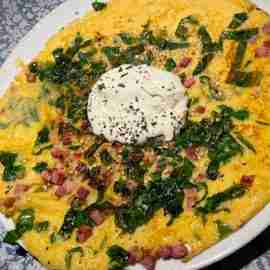 Westphalian Pancakes with Buckwheat, Ramps and Ham
Earthy buckwheat pancakes are topped with fragrant ramps, savory Westphalian ham, and crème fraîche for a rustic spring dish from northwestern Germany.
Rhineland “Dicke Bunne” Fava Beans with Speck
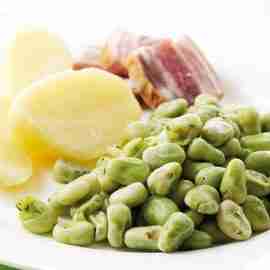 Rhineland “Dicke Bunne” Fava Beans with Speck
This hearty Rhineland brewery snack combines tender fava beans, smoky bacon, savory herbs, and Mettwurst for a comforting dish traditionally served with potatoes.
Rhineland Sauerbraten with Altbier
 Rhineland Sauerbraten with Altbier
This old-world Rhineland Sauerbraten marinates beef in dark German Altbier, vinegar, vegetables, and warm spices before simmering it into a rich, tangy roast with deep regional flavor.
 Simple Potato Pancakes (Reibekuchen)
 Simple Potato Pancakes (Reibekuchen)
Crispy, golden Reibekuchen are classic Rhineland potato pancakes made with grated potatoes, onions, eggs, salt, and pepper, traditionally served with applesauce.
Heaven and Earth (Himmel und Erde)
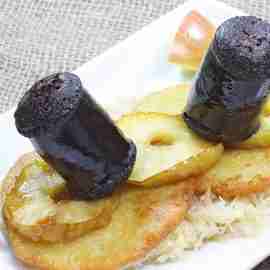 Heaven and Earth (Himmel und Erde)
Himmel und Erde combines creamy potatoes, tart apples, bacon, and onions in a sweet-savory Rhineland comfort dish whose name means “Heaven and Earth.”
Westphalian Wedding Soup (Westfälische Hochzeitssuppe)
 Westphalian Wedding Soup (Westfälische Hochzeitssuppe)
This traditional Westphalian wedding soup features clear beef broth, tender meatballs, vegetables, noodles or Spätzle, and delicate Eierstich egg dumplings.
Bergische Waffles
 Bergische Waffles
 are soft, golden buttermilk waffles sweetened with honey and vanilla sugar, then finished simply with a dusting of powdered sugar.
Pfaelzer Spundkaes
 Pfaelzer Spundkaes
Spundkaes is a creamy, paprika-seasoned spread made with cream cheese, quark, sour cream, onion, and garlic, perfect with potatoes, radishes, fresh bread, or pretzels.
Halve Hahn

A beloved Cologne pub snack, Halve Hahn is a rye roll topped with butter, aged Gouda or Emmentaler, onion rings, mustard, and traditionally served with Kölsch.
Roast Leg of Kid in Dark Beer
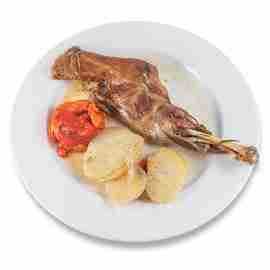
This regional roast features tender young goat seared in butter, slow-roasted with onions, tomatoes, thyme, and dark beer, then served with potatoes, red cabbage, or mashed turnips.
Potato Pancakes with Caramelized Onions and Apples
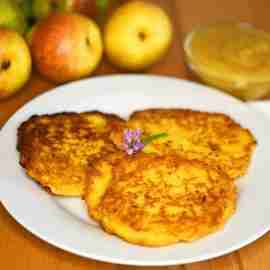
These quick potato pancakes are topped with caramelized onions, tart apples, and sour cream or quark for a sweet-savory twist on classic Reibekuchen.
Pitter and Jupp
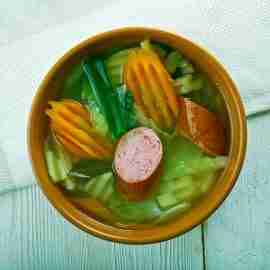
Pitter and Jupp is a hearty North Rhine-Westphalian vegetable soup made with leeks, celery, carrots, potatoes, Savoy cabbage, broth, Mettwurst, herbs, and nutmeg.
Panhas
 Panhas
 is a traditional Westphalian cooked sausage loaf made with minced meat, Mett, blood sausage, buckwheat flour, and warming seasonings, then sliced and pan-fried.
FAQs About North Rhine-Westphalia Cuisine
What food is North Rhine-Westphalia known for?
North Rhine-Westphalia is known for a wide variety of regional foods, including Rheinischer Sauerbraten, Himmel un Ääd, Reibekuchen, Halve Hahn, Currywurst, Bergische waffles, Westphalian pumpernickel, Westphalian ham, Panhas, Pickert, hearty potato dishes, sausages, dark breads, and beer traditions such as Kölsch, Altbier, Dortmunder Export, Warsteiner, and Veltins.
What are the main food regions of North Rhine-Westphalia?
North Rhine-Westphalia can be understood through several culinary regions: the North Rhine cities of Cologne, Bonn, and Düsseldorf; the Ruhrgebiet and Lower Rhine; the Bergisches Land and Sauerland; and Westphalia, including Münster, Bielefeld, and Ostwestfalen-Lippe. Each area has its own ingredients, beers, breads, meats, and local specialties.
What is the difference between Kölsch and Altbier?
Kölsch is Cologne’s pale, refreshing, top-fermented beer traditionally served in a tall, narrow glass called a Stange. Altbier is Düsseldorf’s darker, copper-colored, top-fermented beer with a more assertive flavor. The friendly rivalry between Cologne’s Kölsch and Düsseldorf’s Altbier is part of the region’s culinary identity.
What is Rheinischer Sauerbraten?
Rheinischer Sauerbraten is a classic Rhineland pot roast made by marinating beef for several days, then slowly cooking it until tender. The Rhineland version is especially known for its sweet-sour gravy, often enriched with raisins and sometimes gingerbread or another sweet ingredient.
What is Himmel un Ääd?
Himmel un Ääd, or “Heaven and Earth,” is a traditional Rhineland dish made with potatoes and apples. The name refers to apples from the trees, or “heaven,” and potatoes from the earth. It is often served with fried blood sausage and onions.
What is Halve Hahn?
Halve Hahn is a classic Cologne Brauhaus snack, but despite the name, it does not contain chicken. It is usually made with a rye roll, butter, aged Gouda or Emmentaler, mustard, onions, and sometimes pickles, traditionally served with Kölsch.
What is Bergische Kaffeetafel?
Bergische Kaffeetafel is a generous sweet-and-savory coffee table tradition from the Bergisches Land. It often includes breads, butter, Quark, cheese, cold cuts, honey, apple or sugar-beet syrup, rice pudding, raisin bread, coffee, and Bergische waffles with hot cherries and whipped cream.
What foods come from Westphalia?
Westphalia is known for hearty farmhouse foods such as pumpernickel, rye bread, Westphalian ham, sausages, potatoes, buckwheat, Panhas, Pickert, soups, and substantial meat dishes. These foods reflect the region’s agricultural history of grain farming, pig raising, preservation, and rural cooking.
What is Westphalian pumpernickel?
Westphalian pumpernickel is a dark, dense rye bread traditionally baked or steamed slowly for many hours. Its deep color, moist texture, and slightly sweet flavor make it one of Germany’s most distinctive breads and one of Westphalia’s best-known food traditions.
What is the Ruhrgebiet known for food-wise?
The Ruhrgebiet is known for practical, working-class food shaped by coal, steel, migration, and everyday eating. Currywurst with fries is one of the region’s best-known modern foods, while Dortmunder beer, Pfefferpotthast, Salzkuchen, and Imbiss culture also help define the area.
What foods are popular in the Lower Rhine?
The Lower Rhine, or Niederrhein, is known for asparagus, potatoes, cabbage, strawberries, apples, buckwheat pancakes, beet salads, apple fritters, mussels, Apfelkraut, Rübenkraut, and sweet-and-savory coffee table traditions.
What should food lovers try when visiting North Rhine-Westphalia?
Food lovers should try Kölsch in a Cologne Brauhaus, Altbier in Düsseldorf, Currywurst at a Ruhrgebiet Imbiss, asparagus from the Lower Rhine in spring, Bergische waffles with hot cherries, Sauerland country foods such as trout, mushrooms, game, and beer, and Westphalian bread and ham at a Münster market.
Can North Rhine-Westphalia foods be made at home?
Yes. Many North Rhine-Westphalia dishes can be recreated at home, including Reibekuchen, Sauerbraten, Himmel und Erde, Bergische waffles, Westphalian buckwheat pancakes, fava beans with Speck, wedding soup, potato pancakes, and hearty soups. Pantry items such as Düsseldorf mustard, apple syrup, sugar-beet syrup, pumpernickel, beer, preserves, and German breads can also help bring NRW flavors to an American table.
More to Explore on GermanFoods.org
Recipes from North Rhine-Westphalia – Sauerbraten, Himmel und Erde, Reibekuchen, Halve Hahn, Bergische waffles, Westphalian pancakes, Panhas and other regional specialties.
Guide to German Bread and Cereals – explore Germany’s rye, whole-grain and regional bread traditions, including pumpernickel.
Rhineland-Palatinate: Regional Cuisine and Travel Tips – follow the Rhine south into Germany’s great wine-growing regions.
Germany’s Food Regions & Regional Specialties – continue exploring Germany’s many distinctive culinary regions.
