The authoritative guide to German foods, drinks, and contemporary culinary culture
Search
Rhineland Palatine (Rheinland-Pfalz): Regional Cuisine and Travel Tips
Explore Rheinland-Pfalz, Germany’s leading wine-producing state, from Mosel Riesling and volcanic landscapes to Palatinate chestnuts, river fish, Saumagen, and regional recipes.
Germany’s leading wine-producing state offers far more than vineyards. Rheinland-Pfalz combines Roman history, volcanic landscapes, medieval cathedral cities, forested mountains, mineral springs, and some very distinctive regional foods. From the slate-covered vineyards of the Moselle to the volcanic lakes of the Eifel and the chestnut forests of the Palatinate, the landscape has shaped local culture for nearly two millennia.
The Romans first brought organized viticulture to the region, creating a wine culture that still defines daily life today. Powerful church leaders, imperial electors, French reformers, and democratic revolutionaries all left their mark on the state’s history, while generations of winemakers, farmers, fishermen, and hunters developed a cuisine deeply rooted in local ingredients.
Created in 1946 from several historic territories, Rheinland-Pfalz is one of Germany’s younger federal states but one of its oldest cultural landscapes. Situated at the crossroads of Germany, France, Luxembourg, and Belgium, the region has absorbed influences from its neighbors for centuries. French culinary traditions, Luxembourg’s Moselle wine culture, and the trading connections of the Rhine Valley have all left their mark. The result is a state whose wines, foods, architecture, and customs reflect a unique blend of German and Western European heritage.
Geographical Curiosities
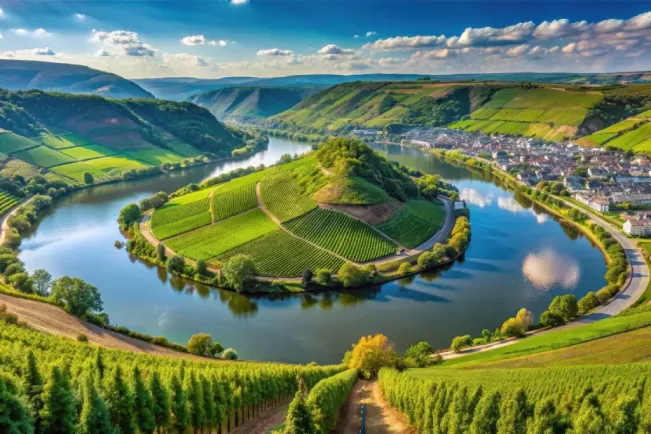
Few German states display such remarkable geographic diversity as Rheinland-Pfalz. Stretching from the French border to the Middle Rhine Valley, the state is shaped by rivers, mountains, forests, volcanic landscapes, and vineyards. The Rhine and Moselle rivers form the backbone of the region, carving dramatic valleys through the ancient Rhenish Slate Mountains (Rheinisches Schiefergebirge) and creating some of Europe’s most celebrated wine landscapes.
Several distinct upland regions give Rheinland-Pfalz its character. The volcanic Eifel in the northwest is known for its crater lakes, called Maare, and for the Nürburgring racing circuit. To the south lies the forested Hunsrück, once a remote farming region whose traditions still influence local cuisine. The Westerwald, in the northeast, is famous for its clay soils, pottery traditions, and rolling hills. Along the state’s western border rises the Palatinate Forest, one of Germany’s largest continuous woodland areas and home to extensive sweet chestnut groves introduced and expanded during Roman times.
One of the state’s most remarkable natural sites is Maria Laach, a volcanic lake formed by an eruption approximately 13,000 years ago. The lake sits beside the famous Benedictine Abbey of Maria Laach and is a reminder that the Eifel remains one of Central Europe’s most geologically active regions. The same volcanic belt extends far beyond Germany, linking the Eifel with the Vosges Mountains of eastern France and continuing toward Hessen. These underground geological forces created the mineral springs that have made towns such as Bad Ems, Bad Kreuznach, and Bad Neuenahr famous spa destinations for centuries.
The region’s geology also shapes its wines. Large portions of northern Rheinland-Pfalz lie on ancient slate formations that absorb heat during the day and release it at night. These soils contribute to the distinctive minerality found in many Rieslings produced along the Moselle and Middle Rhine valleys.
Historical Uniqueness
The story of Rheinland-Pfalz begins long before Germany existed. The Romans arrived nearly 2,000 years ago and transformed the region into one of the most prosperous provinces north of the Alps. Their greatest legacy is Trier, founded as Augusta Treverorum around 16 BC and widely regarded as Germany’s oldest city. Located at the crossroads of major trade routes linking Gaul, the Rhineland, and the Danube frontier, Trier became one of the most important commercial and administrative centers of the Roman Empire.
The Romans also introduced viticulture on a large scale, planting vineyards along the Moselle and Rhine that still produce wine today. They built roads, bridges, bathhouses, and wine presses whose remains can still be seen throughout the region. The connection between Roman engineering, wine culture, and commerce remains visible at every turn.
During the Middle Ages, Rheinland-Pfalz became one of the political centers of the Holy Roman Empire. Powerful Prince-Archbishops based in Mainz ranked among the empire’s most influential rulers and served as Imperial Electors responsible for choosing the Holy Roman Emperor. Their wealth and influence are reflected in the magnificent cathedrals of Mainz, Worms, and Speyer, three of the most important Romanesque churches in Europe. Speyer Cathedral served as the burial place of emperors and kings, while Worms gave its name to the Concordat of Worms of 1122, an agreement that helped settle the struggle between church and state known as the Investiture Controversy.
The region also produced one of Germany’s most remarkable historical figures: Hildegard von Bingen. The 12th-century abbess, composer, healer, scientist, and theologian lived near Bingen on the Rhine and remains one of the most influential women in European intellectual history.
French influence left another lasting mark. Following the French Revolution, much of the region came under French administration during the Napoleonic era. Modern legal structures, property rights, and administrative reforms introduced during this period continued to shape the region long after Napoleon’s defeat.
Rheinland-Pfalz also played an important role in Germany’s democratic development. Hambach Castle near Neustadt an der Weinstraße became a symbol of freedom and national unity during the Hambach Festival of 1832, one of the most important democratic gatherings in German history and a precursor to the revolutions of 1848.
Culinary Culture
The cuisine of Rheinland-Pfalz reflects everything that shaped its history and geography. Roman wine culture, fertile river valleys, dense forests, volcanic mineral springs, and centuries of agricultural traditions all contributed to a cuisine that is hearty, seasonal, and deeply connected to the land.
Wine
Wine remains the defining influence. Rheinland-Pfalz is Germany’s leading wine-producing state and contains some of the country’s most famous wine regions. The Mosel is among Germany’s oldest documented wine-growing areas, while the Pfalz is widely recognized as the world’s largest contiguous Riesling-growing region. Rheinhessen, meanwhile, is Germany’s largest wine-producing area overall. Riesling dominates many vineyards, but Müller-Thurgau, Silvaner, Pinot varieties, and numerous other grapes also thrive here.
Wine Taverns
One of the most charming expressions of this wine culture is the Straußwirtschaft. Along the Rhine, Moselle, Nahe, Ahr rivers wine regions, especially the left banks of the Rhine river valley between Mainz and Koblenz, family winemakers open seasonal taverns in their homes and courtyards. A bouquet, broom, or decorated branch traditionally hung outside signals that the tavern is open and the new wine is ready to be enjoyed. Guests can sample wines produced exclusively from the host’s vineyards while enjoying simple regional dishes.
River Fish
Beyond wine, local cuisine relies heavily on pork, potatoes, freshwater fish, and game. Wild boar, venison, and rabbit reflect the state’s extensive forests, while potatoes became a staple after their introduction from the Americas. The many rivers, cleaned up in the past four decades, provide Trout(Forelle), Char (Saibling), Tench (Schlei), Carp (Karpfen), Pike-Perch (Zander), Perch (Barsch), Pike (Hecht), Eel (Aal), Catfish (Wels), Sturgeon (Stör). You’ll find many of the these fishes on the menus of local restaurants.
Mineral Water
Mineral waters are another regional specialty. The volcanic geology that produced the Eifel crater lakes also created numerous natural springs. Mineral waters from towns such as Bad Ems, Bad Kreuznach, Fachingen, and Gerolstein have been enjoyed for generations and helped establish a thriving spa culture throughout the region.
Hard Cider
While wine dominates much of Rheinland-Pfalz, the areas around Trier, the Saar, and Luxembourg are also known for Viez, a traditional hard apple cider. The name derives from the Latin word vice vinum (“substitute for wine”), a reminder of the region’s Roman heritage. Typically drier and more tart than many commercial ciders, Viez is often served in a distinctive pottery jug known as a Porz and remains a beloved local beverage in the Moselle Valley.
Chestnuts
Sweet chestnuts, known locally as Keschde or Keschte, are among the culinary treasures of the Palatinate. The extensive chestnut groves of the Palatinate Forest are believed to have been introduced or expanded during Roman times and thrive in the region’s unusually mild climate. Every autumn, chestnuts appear in soups, desserts, breads, and festive dishes, while many villages celebrate the harvest with chestnut markets and festivals. Glazed chestnuts and chestnut cream remain among the region’s most popular seasonal specialties.
Almonds, Figs, Lemons & Tobacco
The Rhine Valley and the Palatinate enjoy one of Germany’s warmest climates. Protected by surrounding hills, the region supports vineyards as well as almonds, figs, sweet chestnuts, and even occasional lemon and citrus trees in sheltered locations. Tobacco was also cultivated here for centuries and was once an important crop. A visible reminder of this Mediterranean character is the Pfälzer Mandelpfad (Palatinate Almond Route), where thousands of almond trees burst into pink bloom each spring, often weeks before much of Germany awakens from winter.
Recipes and Regional Favorites
Many traditional dishes reflect the close relationship between wine, agriculture, forests, and rivers.
Perhaps the region’s most famous dish, Saumagen combines pork, potatoes, and spices traditionally cooked inside a cleaned pork stomach. It is typically served with sauerkraut and mashed potatoes.
A German steakhouse favorite from wine-country topped with caramelized onions and served with fried potatoes.
Food Festivals and Places to See
The landscapes, history, and food of Rheinland-Pfalz come together in its many destinations and annual events.
The most famous historic site is the Porta Nigra in Trier, the best-preserved Roman city gate north of the Alps and a symbol of the region’s Roman heritage.
Wine lovers should visit Bacharach on the Middle Rhine. This beautifully preserved medieval wine town offers several traditional Straußwirtschaften where visitors can enjoy local Riesling while overlooking the river and surrounding vineyards.
Every September, Bad Dürkheim hosts the Wurstmarkt, a misnomer as this is widely regarded as the world’s largest wine festival. Founded in 1417, it attracts roughly 600,000 visitors who gather to celebrate Palatine wine, food, and traditions.
Held annually in August in the Moselle town of Wittlich, the Säubrennerkirmes (lit: pig burner carnival) is one of the largest folk festivals in Rheinland-Pfalz, attracting more than 100,000 visitors. The festival’s unusual name, which translates roughly as “Pig Burner Fair,” originates from a medieval legend involving a stolen pig that was accidentally discovered after a fire. Today the event combines carnival rides, parades, live music, wine tents, and regional food specialties. Visitors can sample local Moselle wines alongside traditional dishes from the Eifel and Moselle regions, making the festival one of western Germany’s most colorful celebrations.
The town of Idar-Oberstein, famous for its gemstone industry, is equally proud of its signature dish: Spießbraten. Each summer, the Spießbratenfest celebrates this beloved regional specialty, traditionally consisting of marinated pork roasted slowly over an open beechwood fire. The cooking method originated with gemstone workers who learned grilling techniques while working in South America during the nineteenth century and brought them back to the Hunsrück region. During the festival, visitors can enjoy freshly grilled Spießbraten paired with local beers, wines, and hearty side dishes while experiencing music, entertainment, and the hospitality for which the region is known.
Motorsports enthusiasts make pilgrimages to the Nürburgring in the Eifel, one of the world’s most famous racing circuits. Since 1927 it has hosted legendary races and remains a benchmark for automotive performance.
A very different crowd arrives each August for Nature One, one of Europe’s largest electronic music festivals. Held on a former NATO missile base near Kastellaun in the Hunsrück, the event attracts tens of thousands of visitors from across the continent.
Kaiserslautern, affectionately known as “K-Town,” serves as the center of one of the largest American military communities outside the United States. The city’s strong transatlantic character makes it unlike any other place in Germany.
Whether you come for Roman history, Riesling vineyards, volcanic landscapes, medieval castles, racing circuits, or hearty regional cuisine, Rheinland-Pfalz offers a uniquely German experience shaped by geography, history, and centuries of wine culture.



 The Romans first brought organized viticulture to the region, creating a wine culture that still defines daily life today. Powerful church leaders, imperial electors, French reformers, and democratic revolutionaries all left their mark on the state’s history, while generations of winemakers, farmers, fishermen, and hunters developed a cuisine deeply rooted in local ingredients.